How Media Architecture Breaks Great Creative
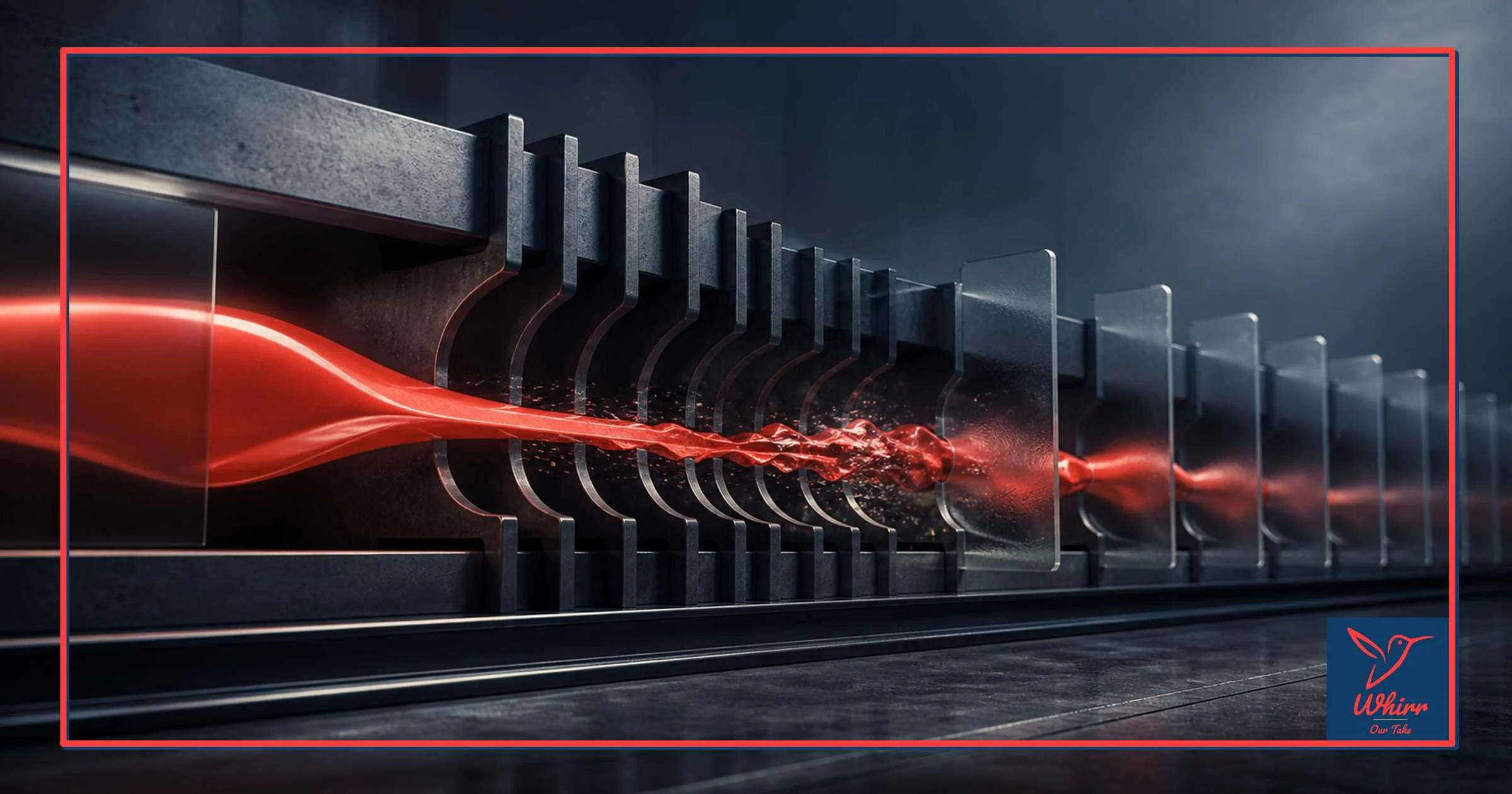
When campaign performance declines, creative is often the first suspect. The asset is labeled tired, the message is replaced, and another production cycle begins.
Sometimes the work truly needs to change. But, the media plan should be examined first.
frequency
audience pools
sequencing
mismatch
budgets
too soon
Media architecture is the structural environment around creative. If that environment is weak, even a strong idea can appear ineffective.
Frequency Can Turn Recognition Into Irritation
Repeated exposure helps build memory, but repetition is not unlimited value.
Audience Pools
Campaigns
Retargeting
Average frequency can conceal the problem because distribution is uneven. Teams need to examine reach curves, high-frequency tails, overlap, time, and the role of each exposure.
The Whirr POV:
Creative fatigue is sometimes media concentration wearing a creative disguise.
✔ Whirr Tip:
Before replacing an asset, inspect frequency distribution and campaign overlap—not just the average.
Placement Context Can Contradict the Idea
An asset designed for sound, motion, or sustained attention may be judged inside a silent, rapid, or visually crowded placement. A detailed product story may be forced into an environment built for immediate recognition.
Delivered in Another.
The answer is not to make every idea identical across channels. It is to preserve the strategic idea while designing executions for the attention and behavior each environment can realistically support.
The Whirr POV:
When placement and creative ask different things from the audience, the media plan wins—and the idea gets blamed.
✔ Whirr Tip:
Create a placement contract for each format: likely attention, sound state, viewing distance, duration, and the single job the asset must do.
Bad Sequencing Makes Every Asset Work Too Hard
A campaign may contain awareness, proof, product, offer, and conversion assets but deliver them as an undifferentiated rotation. Each execution is then expected to introduce the brand, explain the value, overcome objections, and close the sale.
Five Different Jobs. One Undifferentiated Rotation.
Sequencing does not require a perfectly linear journey. It requires a coherent division of labor and enough control to avoid obvious contradictions.
The Whirr POV:
A creative system becomes more powerful when each asset has a role instead of every asset carrying the entire strategy.
✔ Whirr Tip:
Label assets by communication job and check whether the media architecture gives each job a plausible audience and moment.
Testing Structures Can Produce False Creative Lessons
Creative tests are often contaminated by unequal delivery, audience mix, placement, learning phase, or budget. Teams then treat the resulting ranking as a universal truth about the idea.
Different Conditions. One Verdict.
TRUTH
Good testing begins with a decision and controls enough context to make the result interpretable. It also distinguishes an execution finding from a strategic finding.
The Whirr POV:
A platform can rank ads accurately within its delivery system while the organization still draws the wrong lesson.
✔ Whirr Tip:
Write the decision before the test. Record what was controlled, what was not, and where the finding should not be generalized.
A Practical Reset
| 01 | Audit the delivery environment before diagnosing the asset: reach, frequency distribution, overlap, placement, sequence, audience pool, and learning phase. |
| 02 | Give every asset a communication role and verify that the media plan provides a plausible moment for that role. |
| 03 | Design tests around decisions, control what matters, and document limits before converting a platform ranking into a creative principle. |
| 04 | Maintain a joint media-creative review so fatigue, context, and message performance are interpreted together. |
The Whirr Takeaway
Creative does not perform independently. It operates inside a delivery structure that can preserve, distort, or exhaust its value.
Diagnose frequency, context, sequence, and test design before commissioning another replacement. Strong media architecture does not constrain creative; it gives the idea the conditions required to work.